When I began exploring data governance for this blog, I reflected on a personal encounter with its pitfalls. Recently, I fell victim to a data breach from my local post office on the very day I was sending a parcel. That afternoon, I received an SMS claiming the parcel could not be delivered unless I clicked a link and paid R18.20. The timing seemed legitimate, so I clicked. Only to realise later that it was a scam, and the link could have opened the door to digital viruses compromising my personal and financial data – luckily it didn’t.
In this case, data is literally personal. Yet governance extends far beyond individual breaches. It shapes how collective, personal, and nonpersonal data is collected, managed, and used at local, national, and global levels.
As I delved deeper, I realised how profoundly data influences decisions, policies, and daily life. Reflection on how data is handled is no longer optional. Before exploring governance, though, let us start with the basics: what do we mean by data?
What is data?
Data is a collection of facts, numbers, text, images, or other raw information used for reasoning, discussion, or calculation. It may be quantitative, like sales figures, or qualitative, like customer reviews.
When produced in massive quantities from sources such as social media, health records, satellites, or financial transactions, it becomes big data, often applied in AI and machine learning. Analysed well, big data can help detect fraud, improve healthcare, strengthen safety, manage energy, and deliver better public services.
What is data governance?
If data is the raw material of the digital age, governance is how societies manage and protect it. Good governance is about more than compliance. It empowers people to exercise control over their digital lives, also known as digital agency, and enables societies to create value from data, often called digital capital. This includes the skills, infrastructure, and trust needed to turn data into social and economic development.
We see this in practice through tools like Poverty Spotlight, which helps communities measure and address poverty by putting data in the hands of households. Another example is i4Policy’s African Entrepreneurial Ecosystem Index (co-created with various partners), which maps and strengthens conditions for entrepreneurship. Both show how well governed data can drive empowerment and inclusive growth.
As Parminder Jeet Singh explains:
“Data is the raw product for a digital economy. The finished product is digital intelligence, which has real economic value.”
This raises critical questions: who owns data, who decides how it is used, and how do we balance innovation with privacy and sovereignty? Singh notes the goal is not to monetise personal data but to ensure it always benefits people.
At the national level, risks arise when governments centralise control in authoritarian ways or when nations exclude themselves from the digital economy. The alternative is a new social contract around data, built on rights, collective benefit, and digital capital.
Why data governance matters for Africa
The African context holds both promise and challenge. Many countries face weak statistical capacity, outdated systems, and chronic underfunding. Donatien Beguy of the African Population and Health Research Center notes:
“Given the circumstances, you can imagine how difficult it is for African governments to make data driven decisions. This situation is often compounded by the lack of an entrenched culture of data use.”
Nigeria’s 2014 GDP rebasing shows what better data can reveal. Updating economic calculations for the first time in 20 years captured fast growing sectors like entertainment and mobile telecommunications. Nigeria instantly became Africa’s largest economy, reshaping domestic and international perceptions. Yet poverty remained high, showing the limits of headline figures. Without accurate, timely data, governments cannot allocate resources effectively or design responsive policies.
Data governance and deliberation
Governance is often viewed from a technical perspective – the what, how and where. However, it also involves moral dilemmas and tradeoffs (the why), much like artificial intelligence does. UNESCO and i4Policy research shows that:
“When the topic at hand contains values driven dilemmas, complex problems that require tradeoffs, and long term issues… deliberative processes are best suited to guide the development of policy solutions.”
This means citizens, civil society, governments, and businesses must all help shape policy.
Towards a human centred data future
Momentum is building. The Data Governance in Africa initiative, launched in 2023 with sixty million euros from the European Union and partner governments, supports the AU and its member states in building a harmonised, human centred data ecosystem. Its priorities include:
- data policies and regulations developed through broad multi stakeholder dialogue
- skills and capacity building across public and private sectors
- inclusive infrastructure for a secure and sustainable digital market
As Southend Tech notes:
“Organisations that prioritise good data governance unlock their true potential… The choice is simple: embrace governance as an enabler, or let bad governance hold you back.”
i4Policy’s role in strengthening governance
Central to Africa’s digital transformation is the AU Data Policy Framework (AUDPF), adopted in 2022. It provides a continental blueprint for strengthening national data systems, unlocking value, and safeguarding rights. Its objectives include secure cross border flows, personal data protection, innovation, and digital trade. These are essential for digital sovereignty and inclusion.
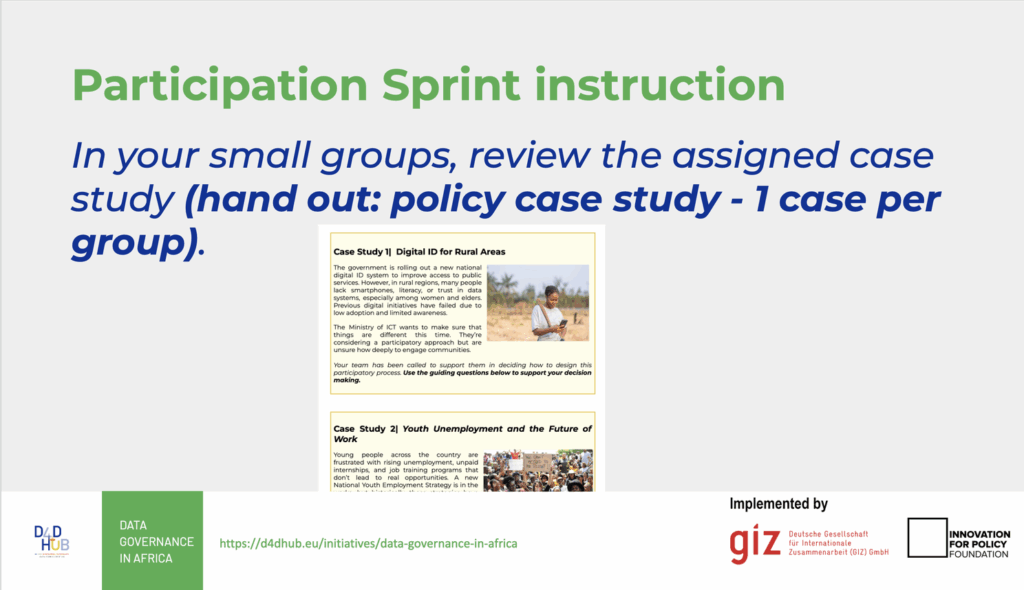
Through the Datacipation project, i4Policy, as a GIZ partner and expert in participatory methodologies and processes, brings this vision to life. We are:
- supporting governments to co-create frameworks with citizens
- enhancing the Citizen Engagement Platform (CEP) as a participatory digital public good
- building capacity for policymakers and civil society to deliberate on governance
- ensuring gender equality and inclusivity remain central to data policy


“At i4Policy, by fostering a participatory and rights based approach, we aim to build a digital future where Africa’s data truly serves Africa’s people.”
For more information on i4Policy and its work, please visit: www.i4policy.org
Author: Belisa Rodrigues, Lead Instructional Designer, Innovation for Policy Foundation.
Note: The views expressed in this article are those of the author and do not necessarily reflect the views of any institution mentioned herein.
References
African Entrepreneurial Ecosystem. (2024). African Entrepreneurial Ecosystem Index. Retrieved from https://africa.ecosystem.build
African Union. (2020). Digital transformation strategy for Africa (2020–2030). Retrieved from https://au.int/en/documents/20200518/digital-transformation-strategy-africa-2020-2030
AU Data Policy Framework, https://au.int/en/documents/20220728/au-data-policy-framework
Beguy, D. (n.d.). Challenges for African governments in making data-driven decisions. African Population and Health Research Center.
D4D Hub. (2023). Data governance in Africa initiative. Jointly implemented by Enabel, Digital Africa, GIZ, ESTDEV, Expertise France, and HAUS. Retrieved from https://d4dhub.eu/data-governance-in-africa
Learning in Reach. (n.d.). Poverty Spotlight. Retrieved from https://learninginreach.org.za/our-impact/poverty-spotlight/
National Bureau of Statistics, Nigeria. (2014). GDP rebasing and re-benchmarking exercise [Press release and technical report]. Retrieved from https://www.nigerianstat.gov.ng/
OECD. (2020). Innovative citizen participation and new democratic institutions: Catching the deliberative wave. OECD Publishing. https://doi.org/10.1787/339306da-en
Singh, P. J. (2019). Why owning their national data is important. IT for Change. Retrieved from https://itforchange.net/index.php/why_owning_their_national_data_is_impt
South-end Tech Limited. (2024, September 23). Why good data governance matters.
UNESCO, & Innovation for Policy Foundation (i4Policy). (2021). Multistakeholder AI development: 10 building blocks for inclusive policy design. UNESCO. Retrieved from https://www.unesco.org/en/articles/multistakeholder-group-discusses-ten-building-blocks-towards-creating-inclusive-ai-policies
World Bank. (2014, April 9). Nigeria’s new GDP rebasing: Implications for Africa’s largest economy. World Bank Blogs. Retrieved from https://blogs.worldbank.org/africacan/nigerias-new-gdp-rebasi